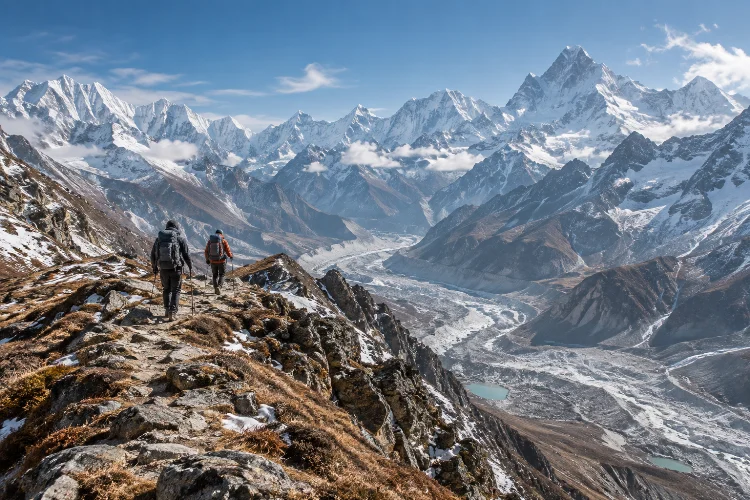
Everest Base Camp and the Annapurna Circuit deserve their legendary reputations, but they represent only a fraction of what trekking in the Himalayas can offer.
Move farther east, west, or into Nepal’s restricted mountain regions, and the trails become longer, quieter, more logistically demanding, and often considerably wilder.
Advanced Himalayan trekking routes beyond Everest and Annapurna include circuits around Manaslu and Dhaulagiri, remote approaches toward Kanchenjunga and Makalu, and expedition-style journeys through Upper Dolpo.
Nepal Tourism Board notes that Kanchenjunga and Dolpo have increasingly attracted trekkers looking beyond the country’s traditional Everest, Annapurna, and Langtang routes.
These are not simply famous treks with fewer people. Many involve passes above 5,000 meters, basic accomodation, longer distances between settlements, restricted-area permits, and greater dependence on guides and support teams.
For experienced hikers, that complexity is exactly what makes them compelling.
What Makes a Himalayan Trek “Advanced”?
Difficulty in the Himalayas is not determined by distance alone.
Altitude, remoteness, weather exposure, trail condition, evacuation access, and the amount of infrastructure available all matter. Nepal Tourism Board notes that many trekking routes reach above 4,000 meters, while several high routes exceed 5,000 meters.
An advanced trek should therefore involve more preparation than simply improving fitness.
You need an itinerary that allows gradual acclimatization, realistic daily elevation gains, spare weather days, and enough time to deal with transport disruption. Equipment also becomes more important when lodges are basic or camping is required.
Current regulations matter too. Nepal Tourism Board lists routes in Manaslu, Kanchenjunga, Makalu, Dolpo, and Dhaulagiri among areas where licensed guides and agency-issued TIMS arrangements apply. Restricted regions can also require additional permits.
Manaslu Circuit: The Natural Step Beyond Classic Trekking
For trekkers moving beyond Nepal’s mainstream circuits, Manaslu is one of the most logical choices.
The route circles the 8,163-meter Manaslu massif and follows the historic Budhi Gandaki corridor before crossing toward the Annapurna side.
Nepal Tourism Board describes the trail as an old salt-trade route and notes that the region transitions from subtropical foothills to high Trans-Himalayan landscapes.
Its appeal is variety.
Early stages follow river gorges, suspension bridges, forests, and cultivated valleys. Higher up, the environment shifts toward Tibetan-influenced villages, monasteries, alpine terrain, and a major high-pass crossing.
Manaslu Conservation Area supports lodge-based trekking, so it is logistically easier than fully camping-based expeditions. The official recommended seasons are generally March–May and September–November.
It is still a restricted-area trek, however, so permit and guide requirements need to be organized correctly.
As of September 11, 2026, Nepal Tourism Board reported that an earlier restriction on an affected Manaslu trail section near Namrung had been lifted, while still advising trekkers to check local conditions before departure.
Kanchenjunga: Trek Into Nepal’s Wild Eastern Himalaya
Kanchenjunga offers a completely different atmosphere.
Situated in far eastern Nepal, the conservation area borders Tibet to the north and India to the east. It covers alpine grasslands, river valleys, temperate forests, and habitats supporting species such as red pandas, snow leopards, blue sheep, and Himalayan black bears.
The main trekking attraction is the enormous Kanchenjunga massif, dominated by the world’s third-highest mountain.
Unlike a short base-camp journey, longer Kanchenjunga itineraries can link northern and southern viewpoints, creating a demanding expedition through settlements that receive far fewer visitors than the Khumbu.
Tea houses exist on established routes, although camping remains part of the broader trekking infrastructure in the conservation area. Nepal Tourism Board recommends spring and autumn as the strongest general seasons.
This is a good choice for experienced trekkers who enjoy cultural isolation as much as mountain scenery.
The remoteness also means your schedule should include spare days. A tight itinerary with no room for delayed transport or slower acclimatisation defeats the purpose of travelling somewhere this isolated.
Makalu Base Camp: Trade Famous Trails for Real Wilderness
Makalu Base Camp feels noticeably more expedition-like.
Makalu-Barun National Park rises through an extraordinary range of ecosystems, from subtropical forest to alpine terrain beneath 8,485-meter Makalu.
Nepal Tourism Board describes the southern approach as one of Nepal’s tougher trekking routes and recommends it for experienced trekkers.
Access commonly begins through Tumlingtar before continuing deeper into the region.
The landscape is the main attraction. Instead of constantly moving through established trekking towns, hikers encounter deep valleys, forest, high pastures, glacier country, and enormous Himalayan walls.
NTB lists camping as the main accommodation style for Makalu-Barun trekking and identifies October–November and March–April as particularly favorable periods.
That changes the logistics considerably.
A camping trek requires more staff, food planning, equipment, and coordination than a classic teahouse itinerary. But it also provides the kind of wilderness enviroment that is becoming increasingly difficult to find on heavily developed Himalayan routes.
Upper Dolpo: Trek Through Nepal’s High-Altitude Interior
Upper Dolpo is for trekkers who care as much about remoteness and culture as dramatic peaks.
Located in northwestern Nepal, Dolpo lies in an isolated high-altitude landscape influenced by Tibetan culture. Nepal Tourism Board specifically identifies Upper Dolpo, Lower Dolpo, and related routes among the country’s regulated trekking areas.
This is not a quick two-week mountain holiday.
Journeys can involve high passes, lengthy camping sections, isolated villages, and large distances between reliable services.
The region also includes Shey-Phoksundo National Park, home to the spectacular Phoksundo Lake. Park entry requirements apply in addition to other trekking permissions.
Upper Dolpo is also a restricted area. NTB’s current permit information lists a special daily fee for designated Upper Dolpo zones, so costs can rise quickly on longer itineraries.
This is one route where attempting to reduce the schedule too aggressively is a bad strategy.
Plan around the landscape, acclimatization, and available camps rather than trying to match the pace of a conventional lodge trek.
Dhaulagiri Circuit: Choose It for Expedition-Style Challenge
The Dhaulagiri massif rises northwest of Pokhara, with 8,167-meter Dhaulagiri I forming the centerpiece of one of Nepal’s most formidable mountain landscapes.
The circuit is very different from simply trekking toward a base camp and returning the same way.
Longer itineraries move through increasingly remote terrain toward the mountain’s glaciated interior before eventually crossing high passes and descending toward the Kali Gandaki region.
Nepal Tourism Board includes Round Dhaulagiri among routes covered by its guide and TIMS requirements.
For trekkers, the attraction is scale.
Days can feel genuinely isolated, and camping support is more important than on well-developed teahouse routes. Cold exposure, high passes, glacial terrain, and unpredictable mountain conditions make proper preperation essential.
Previous high-altitude trekking experience is especially valuable here. Dhaulagiri is better treated as an expedition with trekking sections rather than simply a harder version of Annapurna.
Build Acclimatization Into the Route, Not Around It
High-altitude itineraries become dangerous when the schedule is built around vacation days instead of physiological adaptation.
Do not remove acclimatization stops simply to finish faster. Rest days can still include short hikes to higher elevations followed by sleeping lower, depending on the itinerary and professional guidance.
It is also sensible to maintain flexibility.
Weather may affect high passes, domestic flights, roads, and trail conditions. Nepal Tourism Board’s recent Manaslu notices demonstrate why even established trekking routes can temporarily require adjustments.
Your travel insurance should explicitly cover trekking at the maximum altitude on your chosen route and any evacuation arrangements you may require.
An extra day in Kathmandu is inconvenient. Discovering that your insurance excludes the altitude where you are trekking is considerably worse.
Understand Permits Before Choosing the Route
Permit complexity increases significantly once you move away from Nepal’s most straightforward trekking areas.
Restricted areas require special trekking authorization from Nepal’s Department of Immigration, while protected areas can require separate conservation or national-park entry permits.
Manaslu, Upper Dolpo, and parts of the Kanchenjunga region appear in official restricted-area permit schedules. Fees and rules differ by region and, in some cases, season.
Do not treat permits as something to arrange after arriving at the trailhead.
Work through a government-registered trekking company where required, confirm current rules, and check them again shortly before departure. Regulations, trail access, and local conditions can change.
For advanced trekking, good administration is simply another piece of expedition equipment.
Choose the Route That Matches Your Experience
The “best” advanced Himalayan trek depends on what kind of difficulty you actually enjoy.
Manaslu works well for trekkers wanting a challenging circuit while retaining lodge infrastructure. Kanchenjunga provides longer, quieter exploration in far eastern Nepal, while Makalu leans toward genuine wilderness.
Upper Dolpo is ideal for travellers fascinated by remote highland culture and camping journeys. Dhaulagiri suits people looking for a tougher expedition-style circuit where the mountain terrain itself dominates the experience.
Do not choose based only on maximum altitude.
Think about isolation, consecutive trekking days, accomodation style, high-pass exposure, and how comfortable you are when a schedule changes unexpectedly.
A technically straightforward trail can still feel brutally difficult after ten consecutive days above 4,000 meters.
Advanced Himalayan trekking routes beyond Everest and Annapurna reveal a far wilder side of Nepal.
Manaslu combines a dramatic circuit with established lodges, Kanchenjunga opens the remote eastern Himalaya, Makalu offers deep wilderness, Upper Dolpo mixes high-altitude trekking with extraordinary cultural isolation, and Dhaulagiri delivers an expedition-style challenge.
These journeys reward experience more than speed.
Choose a route that matches your fitness and previous altitude exposure, build generous acclimatization into the itinerary, and organize permits and professional support before committing to dates. Most importantly, leave spare days for weather and changing trail conditions.
If Everest and Annapurna showed you what Himalayan trekking can be, these routes reveal just how much farther the mountains continue.