Korea’s royal history becomes much easier to understand when you stop treating its palaces, tombs, and fortresses as isolated attractions.
Connect them geographically, and they begin to tell a much bigger story – one shaped by kingdoms that moved capitals, adopted new religions, defended strategic rivers, and built ceremonial landscapes around royal power.
Following Korea’s royal heritage trails through historic capitals can take you from the Joseon palaces of Seoul to the grassy royal tombs of Gyeongju, then west toward the former Baekje capitals of Gongju and Buyeo.
Each place represents a different period, so travelling between them feels almost like moving backward through Korean history.
Seoul reveals a highly structured Confucian royal court. Gyeongju preserves remains of the long-lasting Silla kingdom, while Gongju and Buyeo offer archaeological evidence of Baekje’s political and cultural connections across East Asia.
The result is a heritage journey where landscapes matter just as much as monuments.
Start in Seoul With the Royal World of Joseon
Modern skyscrapers make it easy to forget that Seoul – historically Hanyang – served as the political heart of the Joseon Dynasty for centuries.
The best introduction is Gyeongbokgung Palace, the primary palace built after the Joseon capital was moved to Hanyang.
It remains the largest of Seoul’s five surviving royal palaces, and its axial layout gives visitors a clear sense of how ceremonial and governmental space was organized.
Rather than leaving after photographing the main throne hall, look at how courtyards become progressively more controlled as you move deeper into the complex. Royal residences, administrative areas, gates, pavilions, and mountains were all part of a carefully designed political landscape.
This makes Seoul a good starting point because the city still allows visitors to see royalty as part of an urban system rather than simply a collection of decorative buildings.
Walk From Changdeokgung to Jongmyo
For a more intimate picture of Joseon court life, continue to Changdeokgung.
Built in the early 15th century, the palace was originally secondary to Gyeongbokgung but later served as the dynasty’s principal royal residence for long periods.
UNESCO highlights the way its buildings and gardens adapt to natural terrain instead of forcing the landscape into a perfectly rigid plan.
Its famous rear garden is especially useful for understanding Korean palace design. Pavilions, ponds, wooded slopes, and royal residential spaces blend architecture with the landscape.
Nearby Jongmyo presents a completely different side of kingship.
This Confucian royal shrine houses the spirit tablets of Joseon kings and queens and was central to royal ancestral rituals. The ceremonies combined ritual movement, music, song, and dance, emphasizing that royal authority was linked to family lineage and Confucian duty.
Together, Changdeokgung and Jongmyo show that Korean royal heritage involves much more than throne rooms – it also includes nature, ritual, ancestry, and ideology.
Travel Back to the Silla Capital of Gyeongju
Leaving Seoul for Gyeongju means jumping much further back in time.
Gyeongju was the capital of the Silla kingdom, which ruled for almost a millennium, from 57 BCE to 935 CE.
The UNESCO-listed Gyeongju Historic Areas preserve palace remains, temples, fortifications, Buddhist monuments, astronomical structures, and extensive royal burial grounds.
What makes Gyeongju special is that royal history feels embedded in the landscape.
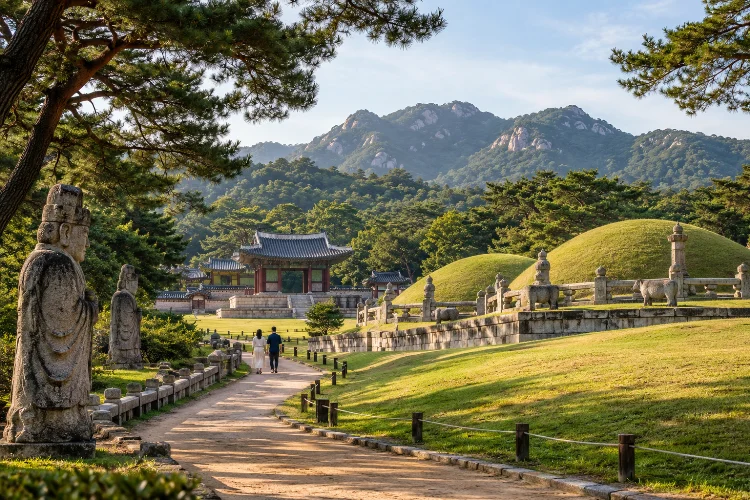
Large grassy burial mounds appear near streets and neighborhoods rather than inside one enclosed archaeological park. Around the Wolseong area, visitors can connect the former palace zone with Cheomseongdae Observatory, Gyerim woodland, and other traces of the ancient capital.
The UNESCO property is actually divided into five major zones, including the Wolseong, Tumuli Park, Mount Namsan, Hwangnyongsa, and fortress areas.
That makes Gyeongju best explored slowly rather than as a checklist of monuments.
Follow Silla Royalty Into Tombs and Buddhist Landscapes
The royal tombs provide one of Gyeongju’s clearest connections to Silla rulers.
The Tumuli Park area contains groups of large burial mounds, some of which produced extraordinary grave goods made from gold, glass, ceramics, and other materials.
These objects reveal both the wealth of Silla elites and the kingdom’s connection to much wider trade and cultural networks.
But royal identity in Gyeongju cannot be separated from Buddhism.
During Silla’s cultural flowering, Buddhist temples, pagodas, sculptures, and sacred landscapes became closely connected with royal patronage. UNESCO records extensive remains across Mount Namsan, including temple ruins, stone statues, pagodas, and rock carvings.
This creates a very different atmosphere from Seoul. Joseon royal sites often communicate power through Confucian order, while Gyeongju’s historcial landscape frequently blends monarchy with Buddhist belief.
Understanding that contrast makes a multi-capital trip much richer.
Explore Gongju, Baekje’s Fortress Capital
From Gyeongju, the royal trail can move west toward Gongju, once known as Ungjin.
Gongju became a Baekje capital during the later period of the kingdom. Its most important heritage sites include Gongsanseong Fortress and the royal tombs at Songsan-ri, both included within the UNESCO-listed Baekje Historic Areas.
Gongsanseong is particularly valuable because it shows how royal capitals depended on geography.
Rather than focusing entirely on monumental architecture, walk the fortress walls and observe the surrounding hills and Geum River. Defensive position, transportation routes, and access to water all influenced where rulers established political centers.
The royal tomb area provides another perspective.
Burial sites help archaeologists reconstruct Baekje court culture through architecture and surviving objects. Seen together, the fortress and tombs turn Gongju into a compact lesson in how security, landscape, and royal identity worked together.
Continue to Buyeo, the Final Baekje Capital
Baekje later transferred its capital to Sabi, present-day Buyeo.
This city represents the kingdom during a period of particularly strong cultural interaction with neighboring regions.
UNESCO notes that Baekje adopted influences from China, developed them in distinctive local ways, and contributed to their transmission toward Japan and other parts of East Asia.
The heritage trail here includes the archaeological remains of Gwanbuk-ri, Busosanseong Fortress, the Jeongnimsa Temple Site, royal tombs at Neungsan-ri, and the Naseong city wall.
Busosanseong is especially rewarding for travellers who enjoy combining history with walking. The wooded fortress landscape provides clues to how the capital used natural terrain as part of its defensive system.
Jeongnimsa offers another dimension. Its surviving stone pagoda helps visitors visualize how Buddhist architecure became part of Baekje’s political and cultural identity.
Buyeo feels less monumental than central Seoul, but that quieter atmosphere often makes its archaeological story easier to appreciate.
Add Iksan for a Broader Baekje Story
A deeper royal heritage itinerary should not completely overlook Iksan.
UNESCO includes the archaeological site at Wanggung-ri and Mireuksa Temple Site within the Baekje Historic Areas. These sites are associated with a secondary capital during the later Sabi period.
Their inclusion is important because ancient political geography was not always as simple as one kingdom having one fixed capital.
Royal courts could maintain secondary centers, temple complexes, defensive landscapes, and administrative locations serving different functions.
Adding Iksan also helps break the habit of seeing ancient Korea exclusively through famous reconstructed palaces.
Here, foundations and archaeological remains demand more imagination, but they reveal how historians piece together the layout and ambitions of vanished royal centers.
For travellers interested in archeaology rather than only intact architecture, it can be one of the most rewarding stops.
Read the Landscape as Part of Royal Power
One theme connects nearly all these historic capitals: rulers rarely chose important sites randomly.
Mountains, rivers, defensible hills, religious spaces, and symbolic geography repeatedly influenced where palaces and capitals developed.
Changdeokgung was designed to work with existing topography, while Gongsanseong and Busosanseong took advantage of elevated terrain. Gyeongju spread royal tombs, palace areas, temples, and fortifications across a broader cultural landscape.
Paying attention to these relationships makes royal heritage much easier to read.
Instead of asking only, “What building is this?” ask why it was positioned there. Look toward nearby mountains, trace rivers on a map, and notice where city walls meet natural barriers.
That simple habit can turn a normal sightseeing trip into a much deeper exploration of Korean history and preservaton.
Build the Journey in Historical Layers
A practical trip does not necessarily need to follow strict chronological order.
Starting in Seoul is convenient and gives you the clearest surviving palace complexes. From there, Gyeongju introduces the Silla world, while Gongju and Buyeo reveal the later capitals of Baekje. Iksan can be added when you have extra time or want more archaeological depth.
The important thing is to give each destination enough space.
Two or three palace visits squeezed into one afternoon can quickly become repetitive. Mixing palaces with tombs, fortress walks, archaeological parks, museums, and traditional neigborhoods creates a more balanced experience.
Museums are particularly useful before archaeological sites. A model, reconstructed floor plan, or collection of excavated objects can make ruins considerably easier to understand once you are standing among them.
Following Korea’s royal heritage trails through historic capitals reveals how dramatically Korean kingship changed across different eras.
Seoul preserves the ceremonial and Confucian world of Joseon, Gyeongju opens a window onto Silla royalty and Buddhist culture, while Gongju, Buyeo, and Iksan trace the shifting political centers of Baekje.
The most rewarding approach is to connect these places instead of treating them as separate tourist attractions. Look at palace layouts, walk fortress walls, explore royal tombs, and pay attention to the mountains and rivers surrounding ancient capitals.
When planning your next Korea itinerary, leave room for at least two historic regions beyond Seoul. Following the country’s former capitals turns a normal sightseeing trip into a journey through centuries of royal power, belief, architecture, and cultural exchange.