Tokyo, Kyoto, and Osaka may dominate a first trip to Japan, but some of the country’s most atmospheric history survives far from high-speed railway platforms.
Follow the old highways into mountain valleys and rural communities, and you begin encountering streets that once existed specifically to feed, shelter, and organize people travelling across the country.
Mapping Japan’s historic post towns beyond the Golden Route opens a completely different view of Japanese travel.
JNTO describes the familiar Golden Route as the well-established visitor corridor that generally links Tokyo with major destinations such as Kyoto and Osaka. Yet Japan’s historical transport network reached much further into the countryside.
During the Edo period, post towns known as shukuba developed along major highways. Inns, teahouses, warehouses, horse stations, shops, and checkpoints supported everyone from merchants and pilgrims to samurai and feudal processions.
Many have disappeared into modern cities. Others, however, still preserve remarkable pieces of the road culture that connected Japan centuries before the Shinkansen.
Why Japan’s Old Post Towns Matter
In the early 17th century, the Tokugawa shogunate organized a major highway system centered on Edo, today’s Tokyo.
The five principal routes, known as the Gokaido, included the Tokaido, Nakasendo, Koshu Kaido, Nikko Kaido, and Oshu Kaido. Post stations were established at intervals to provide horses, manpower, accommodation, and logistical support.
These were not simply roadside hotels.
A busy post town could contain official honjin inns for high-ranking travellers, secondary wakihonjin, ordinary lodging houses, food businesses, craftsmen, shops, storage facilities, and horse services. The entire settlement might depend economically on passing traffic.
Understanding that system changes the way you explore an old town. Instead of simply admiring traditional architecure, you begin asking why the road is shaped a certain way, where travelers slept, and how goods moved from one region to another.
Narai-juku: Go Deeper Into the Nakasendo
Magome and Tsumago are the best-known Nakasendo stops, but Narai-juku deserves at least as much attention.
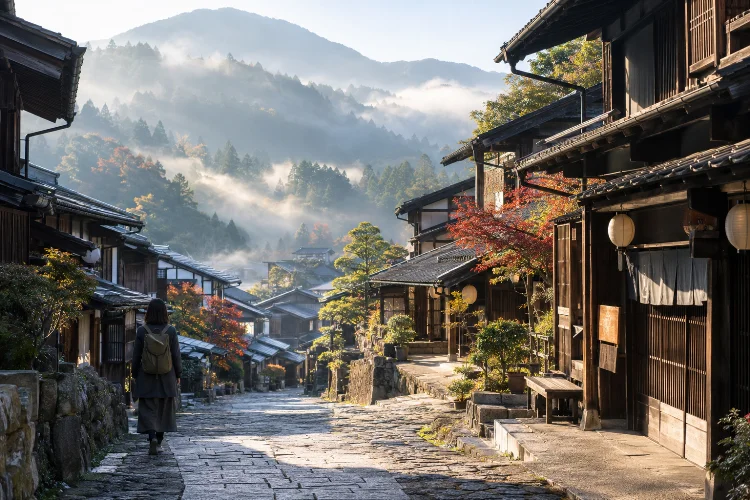
The Nakasendo crossed Japan’s mountainous interior between Edo and Kyoto. Sixty-nine post towns were established along it, and sections through the Kiso Valley remain among the most atmospheric parts of the old highway.
Narai was once the wealthiest of the eleven Nakasendo stations in the Kiso region. Its historic street stretches for more than a kilometer, lined with wooden buildings that now contain restaurants, sake shops, traditional accommodation, and lacquerware businesses.
The town becomes even more interesting when combined with a walk.
From Yabuhara, around five kilometers south, travellers can follow the old route over Torii Pass toward Narai. Parts of the trail retain old cobbling, transforming the visit from a heritage-town photo stop into something closer to experiencing the historical road itself.
Unno-juku: Follow the Lesser-Known Hokkoku Kaido
For a quieter alternative in Nagano Prefecture, look toward Unno-juku in Tomi.
The town dates to 1625 and developed along the Hokkoku Kaido, a route connecting the Nakasendo with northern Japan. It carried traffic associated with Sado Island’s gold and was also used by pilgrims travelling toward Zenkoji Temple.
That makes Unno fascinating because it demonstrates how Japan’s transport network extended beyond the famous five highways.
Its traditional streetscape includes historic houses, willow and cherry trees, and a water channel running beside the road.
JNTO notes that Unno receives fewer visitors than better-known Nakasendo towns such as Magome and Tsumago, which can make its atmosphere feel noticeably more relaxed.
Spend time looking at the building fronts rather than simply walking straight through. Old merchant houses reveal how commerce, domestic life, and road traffic occupied the same narrow space.
Ouchi-juku: A Thatched-Roof Post Town in Fukushima
Head north into Fukushima Prefecture and the visual character changes dramatically.
Ouchi-juku served travellers during the Edo period on the route between the Aizu region and the direction of Nikko and Edo. Today, rows of steep thatched roofs line its broad central street, creating one of Japan’s most recognizable preserved rural townscapes.
The town was designated an Important Preservation District for Groups of Traditional Buildings in 1981. Its traditional appearance has been carefully protected, including efforts to keep modern utility infrastructure from dominating the view.
Ouchi-juku also demonstrates why geography matters when mapping historic roads. It sits in mountainous countryside, where travellers moving largely on foot needed dependable places to rest.
Today, the old houses contain shops, restaurants, and some traditional accommodation. Local negi soba, famously eaten with a large leek, adds a regional food experience to the historical setting.
Visit early or stay nearby if possible. Once day visitors leave, it becomes easier to imagine the road as a functioning mountain settlement rather than a tourism attraction.
Seki-juku: Rediscover the Old Tokaido in Mie
The modern Golden Route roughly overlaps part of the historic east-west corridor between Tokyo and Kyoto, but high-speed rail makes it easy to miss what remains beside the old road.
Seki-juku in Mie Prefecture is an excellent example.
During the Edo period, Seki was the 47th of the Tokaido’s 53 official post stations. In 1843, records show two honjin, two wakihonjin, and 42 ordinary inns serving travellers passing through the settlement.
Its location was strategically valuable. Seki stood near the Suzuka Mountains and close to the junction where travellers could turn toward Ise Grand Shrine.
Today, its historic main street stretches roughly 1.8 kilometers, with around 200 preserved traditional townhouses from the late Edo and Meiji periods contributing to the streetscape.
This is where slowing down pays off. Look for wooden latticework, rooflines, old shopfronts, and the narrow dimensions of historic properties.
Seki shows that you do not always need to travel to a completely remote region to leave the standard tourism circuit. Sometimes the older Japan is hiding just beyond the neigbouring transport corridor.
Mitsumata: Discover a Different Highway in Niigata
Historic post-town travel becomes even more interesting once you leave the best-known roads altogether.
Mitsumata in present-day Yuzawa, Niigata, was once an important settlement on the Mikuni Road, which crossed the mountains between the Edo region and Echigo toward the Sea of Japan.
The wider Mikuni Kaido ran roughly 200 kilometers and included 35 post towns where travellers could eat, sleep, change horses, and arrange transport for goods.
Mitsumata benefited from traffic by officials, merchants, and daimyo processions. One particularly valuable survivor is Ikedaya, established as a wakihonjin in 1828 and housed in a building dating to 1829. It later became a traditional inn after the official post-town system disappeared.
Mitsumata looks very different today because the region is strongly associated with skiing and mountain tourism.
That contrast is exactly what makes it interesting. Historic transport landscapes do not always survive as perfectly preserved open-air museums; sometimes pieces of them remain within communities that have found completely new economic roles.
Read the Road, Not Just the Buildings
A useful way to explore Japanese post towns is to treat the highway itself as the main historical attraction.
Look for old stone paving, water channels, checkpoints, roadside statues, bridges, horse facilities, inns, and entrances designed for different categories of traveller. In some towns, sections of the original road continue into forests or mountain passes.
The Nakasendo is particularly good for this style of travel. Sections between preserved settlements can still be walked, including the popular route between Magome and Tsumago and the quieter approach to Narai via Torii Pass.
Museums can also explain things that are difficult to recognize on the street, especially the distinction between honjin, wakihonjin, ordinary inns, checkpoints, and commercial buildings.
The more context you have, the less these places feel like collections of old houses.
Build a Post-Town Journey Around Regions
Trying to connect every surviving post town into one trip would involve huge distances, so regional planning makes more sense.
For a mountain-road experience, base yourself around Nagano and combine Narai with other Kiso Valley settlements.
For northern heritage, pair Ouchi-juku with Aizu-Wakamatsu. Unno-juku works naturally with eastern Nagano, while Seki-juku can become a historical detour when travelling through Mie.
Mitsumata offers a different option for travellers heading into Niigata’s mountains.
Most importantly, allow more time than a quick photo stop. The strongest preservaton experience usually comes from walking slowly, entering museums and historic inns, tasting regional food, and spending at least part of the day away from peak visitor hours.
Historic towns make more sense when you experience them at walking speed—the same speed used by most travelllers centuries ago.
Mapping Japan’s historic post towns beyond the Golden Route reveals a country connected by roads long before bullet trains made distance feel effortless.
Narai preserves the mountain culture of the Nakasendo, Unno-juku introduces the lesser-known Hokkoku Kaido, Ouchi-juku shows how remote communities supported travellers, Seki-juku preserves an exceptional section of the Tokaido, and Mitsumata opens a window onto the Mikuni Road.
Together, these places make Japanese history feel physical rather than abstract. On your next Japan trip, consider replacing one major-city day with an old-road journey.
Walk part of a former highway, stay in a traditional inn, explore a preserved streetscape, and pay attention to the mountains and valleys around it. You may find that Japan’s most memorable historical stories begin where the Golden Route ends.