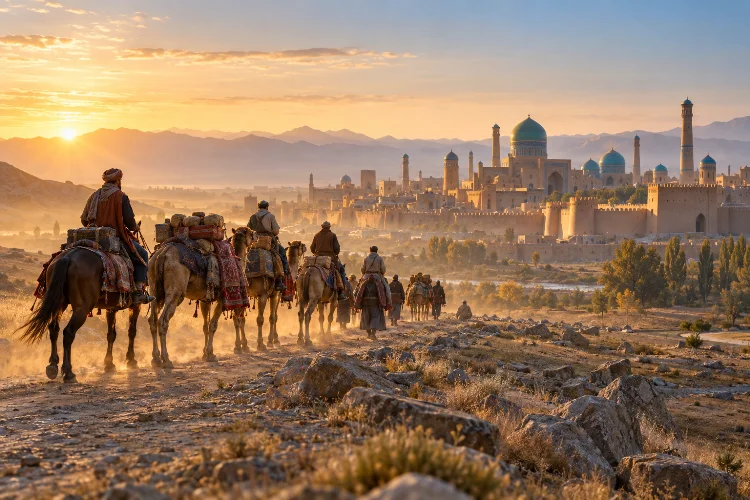
Long before cargo ships, railways, and international airports connected distant economies, merchants crossed Central Asia with camels, horses, textiles, spices, precious metals, and ideas.
Their journeys helped create one of history’s most remarkable commercial networks: the Silk Roads.
Exploring ancient trade routes across Central Asia’s historic cities reveals that these roads were never simply lines connecting China with Europe.
They formed a huge web of caravan trails linking deserts, mountain passes, fertile valleys, oasis settlements, and powerful urban centers.
UNESCO notes that Silk Roads cities became places where merchants could rest, trade goods, exchange knowledge, and interact with different cultures.
Cities such as Samarkand, Bukhara, Merv, Khiva, and Khujand became much more than trading posts. They developed into centers of scholarship, religion, craftsmanship, diplomacy, and architecture.
Today, travelling through these places offers an unusual opportunity to follow routes where globalisation was taking shape centuries before the modern term even existed.
The Silk Roads Were a Network, Not a Single Road
The popular image of the Silk Road as one long highway stretching from China to Europe is convenient, but historically inaccurate. In reality, merchants followed multiple routes that changed depending on political stability, water supplies, geography, taxes, and security.
Caravans moved through river valleys when possible, crossed mountain passes during suitable seasons, and depended heavily on oasis cities for food and water. Routes could shift when a city became unsafe or when another regional power offered better trading conditions.
One important example is the Zarafshan-Karakum Corridor, now recognized as a UNESCO World Heritage property.
The corridor stretches roughly 866 kilometers through areas of present-day Tajikistan, Uzbekistan, and Turkmenistan, linking the Zarafshan River region with the Merv Oasis across the Karakum Desert.
UNESCO describes it as a major route for exchange from around the 2nd century BCE until the 16th century CE.
That enormous time span shows how adaptable Central Asian commerce was. Routes changed, empires disappeared, and new cities rose, yet long-distance trade continued.
Samarkand: The Great Crossroads of Central Asia
Few cities represent Silk Road history as strongly as Samarkand.
Located in the fertile Zerafshan River valley of modern Uzbekistan, the city occupied a strategic position between Persia, China, India, and the Eurasian steppe.
UNESCO describes Samarkand as a crossroads and melting pot of world cultures with more than two and a half millennia of history.
Ancient Samarkand was known as Afrasiab, with the city traditionally dated to around the 7th century BCE. Archaeological remains reveal fortifications, residential districts, craft areas, palaces, and religious buildings.
Merchants arriving here could exchange Chinese silk, Central Asian horses, Persian textiles, metal goods, ceramics, spices, and other valuable products. But Samarkand’s significance was never limited to merchandise.
Languages, artistic styles, technologies, religious ideas, and scientific knowledge moved through the city too.
Its later transformation under Timur and the Timurids during the 14th and 15th centuries created many of the spectacular architectural landmarks associated with Samarkand today, including Registan, Bibi-Khanum Mosque, Shah-i-Zinda, and Gur-e Amir.
Bukhara: Where Trade and Scholarship Came Together
Travel west from Samarkand and another major Silk Road city appears: Bukhara.
Bukhara has existed for more than 2,000 years and became one of Central Asia’s most important economic and cultural centers.
Its position on international caravan routes allowed merchants from numerous regions to gather inside its markets, workshops, and caravan facilities. UNESCO describes its historic center as one of the best-preserved examples of a medieval Central Asian city.
Commerce helped finance something equally important: intellectual life.
Over the centuries, Bukhara developed into a prominent center of Islamic learning, attracting scholars, students, theologians, and scientists. Mosques and madrasas became part of an urban enviroment shaped by both trade and education.
Walking through the old city today, visitors can still see how religious buildings, markets, workshops, courtyards, and narrow streets developed close together.
Bukhara demonstrates an important lesson about ancient commerce: successful trading cities often became knowledge centers because travelling merchants also transported books, beliefs, languages, and information.
Merv: A Desert Oasis With Global Connections
Further southwest, in modern Turkmenistan, stood another giant of Central Asian trade: Merv.
Its location in the Murghab River oasis made the city an essential stopping point before difficult desert crossings. Water and agriculture allowed large communities to survive in a region surrounded by an otherwise challenging landscape.
UNESCO describes Ancient Merv as the oldest and most completely preserved group of oasis cities along the Silk Roads in Central Asia. Human settlement in the wider oasis stretches back to the 3rd millennium BCE.
Merv reached particular importance during the Islamic period. It served as a major regional political center and later became a capital of the Great Seljuk Empire during the 11th and 12th centuries.
For merchants, reaching Merv meant access to markets, supplies, accommodation, craftsmen, and connections leading toward Persia, Mesopotamia, Afghanistan, and the wider Middle East.
Its extensive archaeolgical remains also show how Silk Road cities could physically move over time. Different fortified settlements developed beside earlier ones as political and economic conditions changed.
Khiva: The Caravan Gateway Across the Desert
Khiva represents another side of Central Asian trading history.
Located south of the Amu Darya in Uzbekistan’s Khorezm region, the city sat near important routes running between Central Asia, Persia, and territories around the Caspian Sea.
Its walled inner city, known as Itchan Kala, preserves much of the atmosphere associated with historic caravan settlements.
According to UNESCO, Khiva served as the last major resting point for caravans before crossing the desert toward Persia.
That role made reliable infrastructure extremely valuable. Merchants needed water, food, animals, storage facilities, markets, and places to sleep before continuing through harsh terrain.
Although much of today’s architecture dates from later periods, Khiva still illustrates how caravan-based economies influenced urban design. Markets, mosques, madrasas, defensive walls, workshops, and caravanserais were closely connected.
For modern travellers, the compact historic center makes these relationships unusually easy to understand on foot.
The Fergana Valley and Routes Toward the East
Not every important Silk Road route crossed the open desert.
East of Samarkand, the Fergana Valley created another major corridor connecting Central Asian cities with mountain routes leading toward what is now western China.
The broader Fergana-Syrdarya network linked settlements across parts of modern Uzbekistan, Tajikistan, Kazakhstan, and Kyrgyzstan.
Historical routes followed major rivers and connected agricultural areas, fortified cities, caravan stations, and mountain passages. UNESCO notes that the importance of individual settlements changed repeatedly as political and economic circumstances shifted.
Khujand, located along the Syr Darya in present-day Tajikistan, became one of the region’s notable trading centers.
The Fergana Valley was also famous for horses, agricultural products, and fertile land. These resources made it valuable not only as a passageway but as an economic region in its own right.
Merchants were constantly adapating their journeys according to weather, security, and available markets.
What Actually Travelled Along These Ancient Routes?
Silk gave the network its famous modern name, but caravans carried far more than silk.
Depending on location and period, traded products included horses, wool, cotton, spices, ceramics, glassware, precious stones, metal objects, paper, leather, jewelry, textiles, and agricultural goods.
Luxury products could travel enormous distances, although the same merchant rarely travelled the entire route. Goods often changed hands many times between regional traders.
The Metropolitan Museum of Art notes that trade through southern Central Asia connected oasis settlements with wider economic networks between eastern and western regions.
Ideas moved with those goods.
Buddhism, Islam, Christianity, artistic techniques, scientific knowledge, musical traditions, languages, and technologies all crossed cultural boundaries through travelling communities.
This cultural exchange may be the Silk Roads’ most important legacy.
Following the Ancient Routes Today
Modern travellers cannot recreate a historical caravan journey exactly, but Central Asia remains one of the world’s best regions for seeing Silk Road geography firsthand.
A practical historical route might begin around the Fergana Valley, continue to Samarkand and Bukhara, travel west toward Khiva, and then connect conceptually with routes running toward Merv in Turkmenistan.
Instead of simply checking monuments off a list, pay attention to geography.
Notice where cities sit beside rivers, how deserts separate major settlements, where defensive walls were built, and why markets developed close to major gates. These details explain why particular cities became powerful trading hubs.
Museums and archaeolgical sites can add another layer of understanding. Coins, pottery, imported materials, wall paintings, jewelry, and manuscripts frequently reveal connections that architecture alone cannot show.
Exploring ancient trade routes across Central Asia’s historic cities is really an exploration of early global connection.
Samarkand linked cultures from multiple directions, Bukhara combined commerce with scholarship, Merv flourished around a vital desert oasis, while Khiva helped caravans prepare for demanding journeys across arid landscapes.
Together, these cities show that the Silk Roads were much more than trading routes. They were channels through which technologies, religions, artistic traditions, languages, and knowledge travelled between societies.
For travellers interested in history, architecture, or cultural exchange, Central Asia offers one of the most fascinating historical journeys anywhere in the world.
Rather than visiting each city as an isolated destination, try following the old caravan geography and seeing how every stop fits into a much larger story.