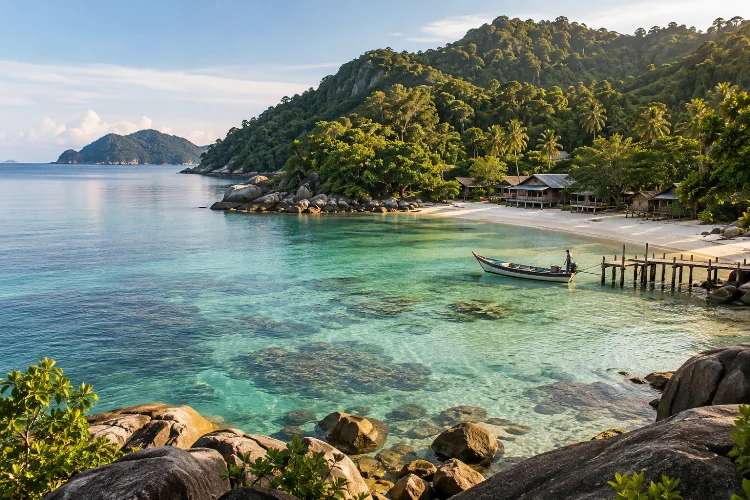
Malaysia’s east coast is often reduced to a few familiar island names, but the South China Sea holds a much larger collection of tropical escapes.
From the Perhentian Islands in northern Terengganu to the remote clusters off Johor, the coastline is dotted with coral reefs, forested hills, fishing communities, tiny resorts, and beaches that can feel surprisingly isolated.
Remote island travel across Malaysia’s east coast archipelagos becomes especially rewarding when you stop thinking of these places as interchangeable beach destinations.
Perhentian is ideal for easy snorkeling and backpacker-friendly stays, Tenggol appeals to experienced divers, Tioman combines jungle and marine life, while Johor’s smaller islands offer a quieter, more compact escape.
Tourism Malaysia identifies Redang, Perhentian, Lang Tengah, Kapas, and Tenggol as some of Terengganu’s standout islands, while farther south the marine parks around Tioman and Mersing extend the island chain through Pahang and Johor.
The trick is knowing where to slow down.
Start With the Perhentian Islands for an Easy Introduction
The Perhentian Islands are among the easiest places to begin exploring Malaysia’s east coast.
The destination is divided between Perhentian Kecil and Perhentian Besar. Kecil generally has a younger and more casual atmosphere, while Besar tends to feel quieter and more resort-oriented.
Both are part of a marine-park environment known for clear water, coral reefs, reef fish, and turtle sightings. Tourism Malaysia specifically highlights the islands as one of the country’s strong diving destinations.
Access is relatively straightforward. Boats normally leave from Kuala Besut, with Tourism Malaysia listing journey times of roughly 20-30 minutes.
Perhentian works well if you want a remote-island atmosphere without complicated logistics. Spend at least three nights so you have time for snorkeling trips, short jungle walks, and slower afternoons away from the main beaches.
Choose Lang Tengah for More Seclusion
Between Perhentian and Redang sits Lang Tengah, a much smaller island that often gets overlooked.
That is exactly why it is appealing.
Tourism Malaysia describes Lang Tengah as one of Terengganu’s quieter island escapes, with white sand, aquamarine water, hard and soft corals, and abundant marine life.
It lies between Redang and Perhentian and can be reached by boat, including connections of roughly 30 minutes from Redang.
There is less happening here on land, which is part of the point.
Days tend to revolve around snorkeling, diving, swimming, reading, and walking short stretches of beach. Travelers who need nightlife or endless restaurant choices may find it too quiet, but those looking for genuine downtime often prefer it.
Because accommodation is more limited than on bigger islands, booking ahead makes sense during the main season.
Explore Redang for Reefs and Easier Resort Comfort
Redang is one of the largest and best-known islands off Terengganu.
Compared with some smaller islands, it offers more developed resort infrastructure while still providing excellent access to reefs. Tourism Malaysia describes Redang as a major diving destination with clear water, coral gardens, and soft white beaches.
That makes it a useful middle ground.
You can enjoy comfortable accommodation while still spending most of your time snorkeling, diving, kayaking, or exploring the coastline. It is particularly suitable for travelers who like nature but do not necessarily want the basic facilities found on more remote islands.
Redang can be reached from Kuala Terengganu, including services from Shahbandar Jetty. Tourism Malaysia lists the sea journey at around 1.5 hours, although schedules and departure points should always be reconfirmed before travelling.
The mistake is treating Redang as only a resort island. Get into the water and its real character becomes much clearer.
Slow Down on Tiny Pulau Kapas
Pulau Kapas is much closer to the mainland than many of Malaysia’s other east coast islands.
Boats leave from Marang, with crossings typically taking around 20-30 minutes according to Tourism Malaysia.
Its easy access makes Kapas popular for short stays, but spending several nights is far better than treating it purely as a day trip.
The island has beaches, reefs, and a relaxed scale that makes it easy to move around without complicated transport. Tourism Malaysia also identifies Kapas as a diving and snorkeling destination, with reef fish and coral environments close to shore.
Kapas is especially good for travelers who enjoy simplicity. There are fewer distractions, less road transport, and no need to build an elaborate daily itinerary.
Bring what you need from the mainland because services are more limited, and expect the pace to be considerably slower than in major Malaysian resort destinations.
Head to Tenggol for Serious Diving
Tenggol is a different kind of island experience.
It is smaller, more remote, and particularly well known among divers. Tourism Malaysia notes that Tenggol offers more than 20 dive sites and is especially associated with wall diving.
That makes it less suitable for travelers whose main priority is cafés, beach bars, or casual sightseeing.
The attraction is underwater.
Deep-water conditions and more advanced dive environments mean experienced divers often get more from Tenggol than complete beginners. Its relative isolation also means accomodation and services are limited compared with Redang or Perhentian.
Access is generally through Kuala Dungun. Tourism Malaysia lists the boat journey from Dungun at around 1.5 hours.
If diving is the main purpose of your trip, Tenggol deserves more attention than it usually gets.
Cross Into Pahang for the Bigger World of Tioman
Farther south, Tioman is one of the most complete island destinations on Malaysia’s east coast.
The island covers about 136 square kilometers and combines coral reefs, beaches, forested mountains, waterfalls, villages, snorkeling, diving, and jungle walks. Tourism Malaysia notes that Tioman contains seven settlements and forms part of the Tioman Island Marine Park.
This makes Tioman different from tiny resort islands where nearly everything revolves around one beach.
You can stay in different villages depending on the experience you want. Some areas are livelier and easier to access, while others feel noticeably more isolated.
Tioman is also strong for travelers who want activities on land. Jungle routes and forest interiors offer a break from days spent entirely underwater.
Because the island is larger, do not assume you can easily see everything in two days. Choose a village base and explore from there rather than spending your trip constantly changing accomodation.
Go South to Johor’s Lesser-Known Island Clusters
The islands off Mersing offer some of the best options for travelers who want to move beyond Malaysia’s famous names.
The Sultan Iskandar Marine Park includes island groups around Pulau Tinggi, Aur, Pemanggil, Besar, Sibu, and Rawa. Tourism Malaysia describes the area as covering multiple island clusters with beaches, reefs, forest, and marine life.
Rawa is one of the easiest introductions. It lies around 16 kilometers from Mersing and can be reached by a speedboat journey of roughly 20 minutes.
For something much more remote, Pulau Aur is a better choice.
Tourism Malaysia describes Aur as one of Johor’s more distant diving islands, approximately two hours from Mersing by speedboat. Deep surrounding waters attract experienced divers, and the island has simpler accommodation than mainstream resorts.
This southern archipelago feels far more scattered, so good planning matters.
Plan Around the Northeast Monsoon
Timing is one of the most important parts of east coast island travel.
Tourism Malaysia’s 2026 travel guidance recommends roughly March to October for east coast islands such as Perhentian, Redang, and Tioman.
From November to February, the northeast monsoon can bring heavy rain, stronger waves, ferry disruption, and seasonal resort closures.
That does not mean weather is guaranteed outside the monsoon period.
Sea conditions can still change, so ferry schedules should always be checked shortly before travel. Avoid placing an international flight immediately after a remote-island boat transfer.
A buffer night on the mainland can save a lot of stress.
This is particularly important when travelling to smaller islands where ferries or resort boats operate less frequantly.
Treat the Marine Parks as More Than Scenery
The east coast islands are beautiful because their marine ecosystems remain central to the experience.
Snorkeling and diving should therefore come with basic responsibility.
Tourism Malaysia specifically advises visitors not to touch marine animals while diving or snorkeling. The same principle applies to coral: avoid standing on reefs, chasing turtles, feeding wildlife, or taking anything from the sea.
Small choices matter more on islands where ecosystems are fragile and waste-management systems can be limited.
Carry reusable water containers when practical, minimize single-use plastics, and use operators that take reef protection seriously.
Remote travel is more rewarding when your presence does not make the destination less remote – or less healthy – for the next visitor.
Build Your Route by State, Not by Island Count
Trying to visit every island from Perhentian to Johor in one short trip creates more transfers than experiences.
A better strategy is to focus on one section of the coast.
For a Terengganu trip, combine Perhentian with Lang Tengah or Redang. Kapas works well for a shorter mainland-linked escape, while Tenggol makes sense as a specialist diving destination.
For a southern itinerary, Tioman can stand alone for several days before continuing toward Mersing and Johor’s island groups.
The goal should not be to collect the most islands.
Good remote island travel is about choosing fewer places, staying longer, and letting the weather, reefs, villages, and ferry rhythms shape the trip.
Remote island travel across Malaysia’s east coast archipelagos reveals a surprisingly varied chain of tropical destinations.
Perhentian combines easy access with marine life, Lang Tengah offers quieter beaches, Redang adds comfortable resort infrastructure, Kapas keeps things simple, and Tenggol rewards serious divers.
Farther south, Tioman mixes reefs with jungle landscapes, while the islands around Mersing open the door to smaller and more secluded escapes such as Rawa and Aur.
The key is timing. Travel during the calmer east coast season, build flexibility around ferry schedules, and avoid squeezing too many islands into one itinerary.
Pick one regional cluster, stay several nights, and explore it properly. The slower you travel, the more Malaysia’s east coast starts to feel like an archipelago rather than a collection of beach stops.